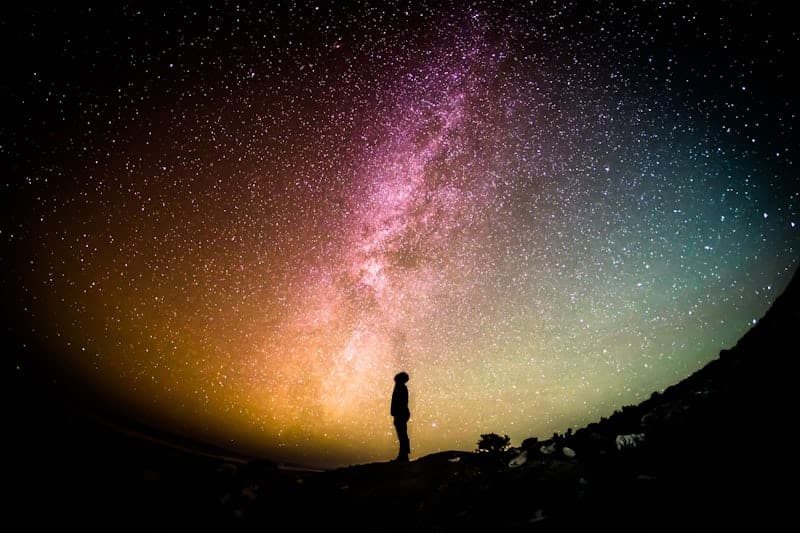
Learn about constellations and stargaze
Study star charts or use a sky map app to identify constellations, then head outside to spot them for real.
- Time:
- 60 min
- Cost:
- free
- Difficulty:
- easy
- Where:
- Outdoors
- Best:
- Solo
The way to learn to identify constellations is not to memorise eighty-eight of them. It is to learn a few unmistakable anchor patterns and then navigate outward from those, which is how every experienced observer actually finds anything. Six shapes gets you around the entire visible sky.
Why learn about constellations and stargaze is worth an hour
Star hopping works because the bright anchor patterns point at things. The Plough's outer stars lead to the pole star, Orion's belt points toward two other bright stars, and each of those opens a new region. Learning the pointers rather than the pictures means you can find your way even when only part of the sky is clear.
How to learn about constellations and stargaze step by step
- 1
Learn your two anchor patterns first
Whatever is unmistakable from your latitude and season. Everything else will be found by reference to these.
- 2
Use the pointers deliberately
The stars that line up and lead somewhere. This is star hopping, and it is the actual technique.
- 3
Learn one new constellation per session
Found from an anchor you already know. Attempting six in a night means remembering none of them.
- 4
Check with an app, then look again
Confirm rather than lead with it. Finding it yourself first is what makes it memorable.
- 5
Note what is seasonal
Most constellations are visible only part of the year. Knowing which explains why one is missing tonight.
Tips to get more out of it
- Learn a couple of named bright stars too. They are useful reference points and easier to spot than whole patterns.
- A red torch preserves dark adaptation, which takes twenty minutes to build and one white light to destroy.
- Sketch what you see. Drawing a pattern fixes it in memory far better than photographing it.
Ways to mix it up
If you want the science behind what you are looking at rather than the patterns, that is a different and equally good hour. If you want the outing itself, getting to a properly dark site changes the experience more than any amount of pattern knowledge.
Learn about constellations and stargaze: frequently asked questions
How many constellations should I learn?
Start with two anchors and add one per session. Six patterns lets you navigate to almost anything visible.
What is star hopping?
Using bright stars in a known pattern as pointers toward a neighbouring one. It is how experienced observers find things.
Do I need a telescope?
No. Constellations are naked-eye objects, and a telescope's narrow field actually makes learning patterns harder.
Related activities
Outdoor
Go stargazing in a dark area
Head somewhere with minimal light pollution, look up, and marvel at constellations, planets, and the Milky Way.
Learning
Learn about astronomy
Dive into planets, galaxies, and cosmic phenomena—the universe is vast and endlessly fascinating to explore.
Outdoor
Watch clouds and find shapes in them
Lie back on the grass, slow your thoughts, and let your imagination turn clouds into stories.