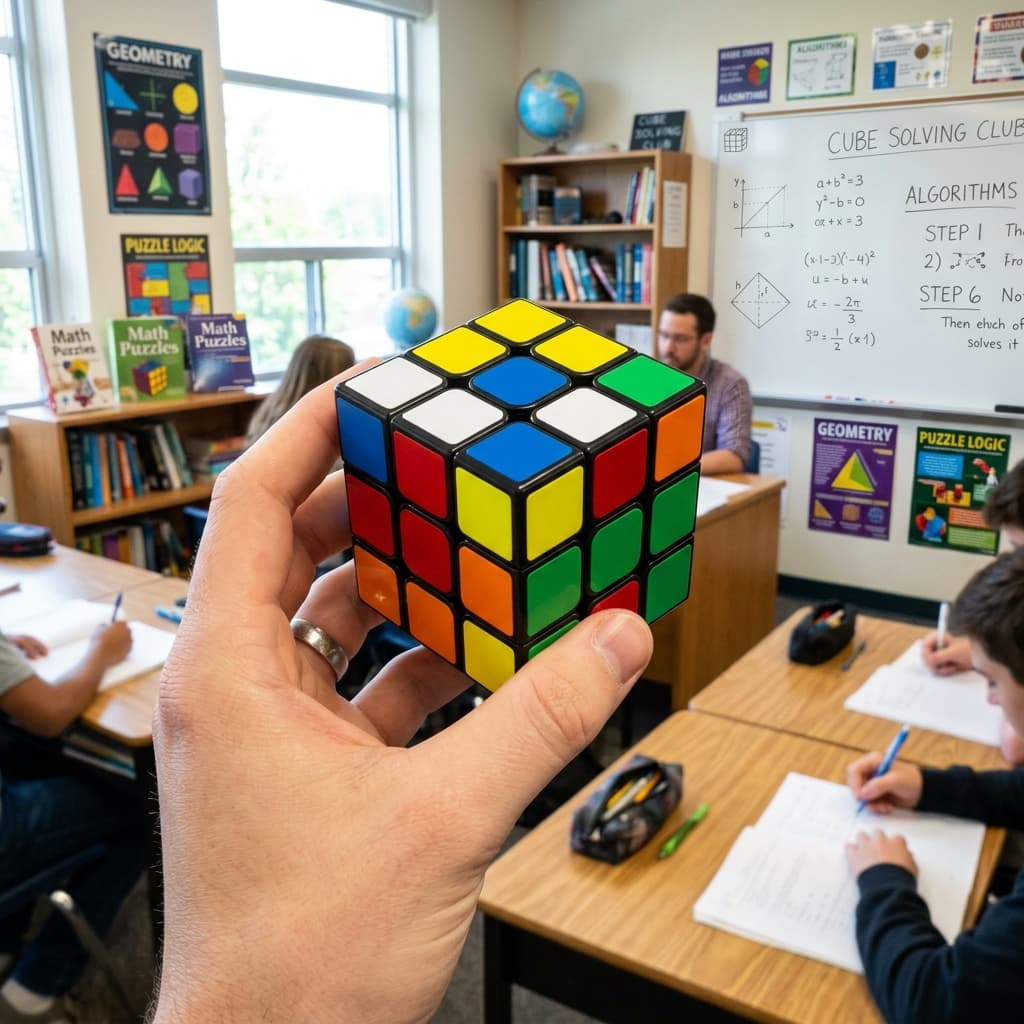
Learn to solve a Rubik's cube
Follow beginner algorithms to solve the classic puzzle layer by layer—a satisfying brain workout once it clicks.
- Time:
- 60 min
- Cost:
- low
- Difficulty:
- challenging
- Where:
- Indoors
- Best:
- Solo
Almost nobody solves a Rubik's cube by working it out. To learn to solve a Rubik's cube you memorise a small set of move sequences and apply them in order, layer by layer, and that is what everyone from beginners to world record holders is doing. Knowing this in advance removes the sense that you should be reasoning it through.
Why learn to solve a Rubik's cube is worth an hour
The beginner method decomposes an impossible-seeming problem into stages where each algorithm changes a few pieces while leaving the solved parts intact. That property is what makes the whole thing tractable. Learning notation first matters more than it appears, because every tutorial and algorithm is written in it and it takes about five minutes.
How to learn to solve a Rubik's cube step by step
- 1
Learn the notation first
Letters for each face, with an apostrophe for anticlockwise. Five minutes, and every guide becomes readable.
- 2
Solve the first layer intuitively
Cross, then corners. This stage genuinely can be worked out and builds a feel for how pieces travel.
- 3
Learn the middle-layer algorithm
One sequence, mirrored for left and right. This is the first point where memorization replaces reasoning.
- 4
Learn the last-layer sequences
A few more algorithms for orienting and permuting. This is the stage people abandon, and it is only memorization.
- 5
Repeat a full solve three times
Consecutively. The sequences move from paper into your hands somewhere around the third attempt.
Tips to get more out of it
- Buy a cheap modern speedcube rather than using an old stiff one. Turning quality genuinely affects how quickly you learn.
- Write the algorithms on a card. Reaching for a phone mid-solve breaks the pattern you are trying to build.
- Do not chase speed yet. Accuracy first; timing is a separate hobby that starts after you can solve reliably.
Ways to mix it up
If memorization is the obstacle, learn one stage per sitting rather than the whole method at once. If you already solve it, learning to do so blindfolded is far more approachable than it sounds and uses the same underlying principles.
Learn to solve a Rubik's cube: frequently asked questions
How long does it take to learn?
Most people complete a first solve within a few hours using the beginner method, and become reliable within a week.
Do I have to memorise algorithms?
Yes, but only about five or six for the beginner method. Nobody solves a cube purely by reasoning.
Does the type of cube matter?
Considerably. A cheap modern speedcube turns far more smoothly than an old stiff one and makes learning much easier.
Related activities
Games
Try puzzle games like Sudoku
Work through logic puzzles that exercise your reasoning and pattern recognition—satisfying to complete and great for focus.
Learning
Learn magic tricks
Practice sleight-of-hand card tricks or coin illusions to entertain friends and sharpen your dexterity.
Games
Start a jigsaw puzzle
Start a jigsaw puzzle by choosing a size that fits your space and available time.