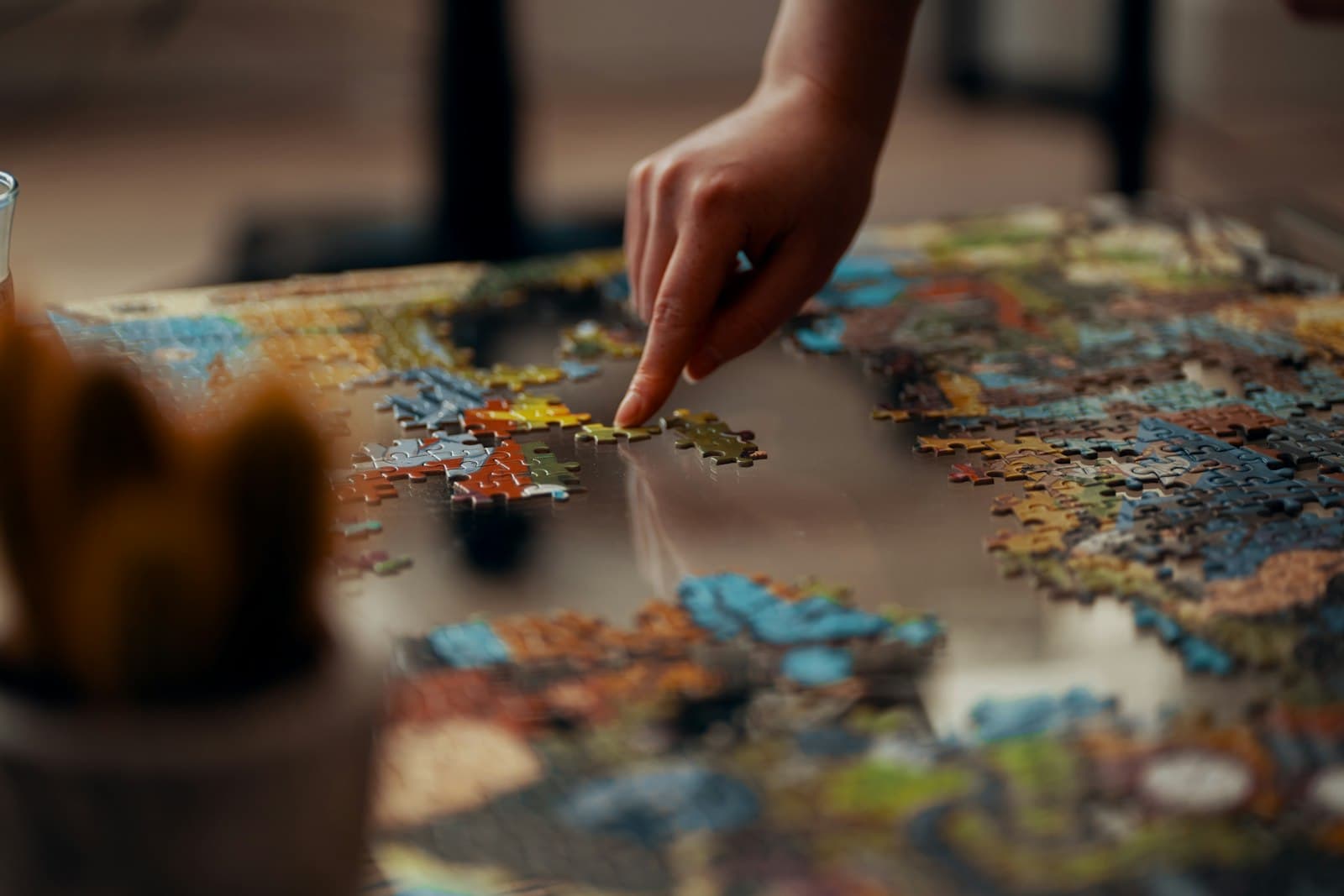
Start a Jigsaw Puzzle: Sorting and Small Sections
Start a jigsaw puzzle by choosing a size that fits your space and available time.
- Time:
- 60 min
- Cost:
- low
- Difficulty:
- easy
- Where:
- Indoors
- Best:
- Solo
Start a jigsaw puzzle by choosing a size that fits your space and available time. A spare hour can be enough to sort pieces and finish one small area even when the whole puzzle takes longer. Keep the box picture nearby and use a surface where unfinished work can stay safely.
Make progress without sorting every piece
Turn pieces face up, put obvious edge pieces aside and choose one distinctive colour or feature. Build a small section around that feature, checking the image and piece shapes together. Edges can help establish the layout, but you do not have to complete the border first.
Use trays for loose groups and keep pieces away from pets or small children. Stop before frustration makes you force pieces together. Photograph the work if you need to move it, and store unfinished sections on a suitable board or mat.
Why start a jigsaw puzzle is worth an hour
Searching a heap of a thousand face-down pieces for one shape is a slow linear scan. Sorting converts that into looking through a group of forty, which is the whole gain. Working in sections rather than across the whole picture compounds it further, since a section keeps the search space small and gives you visible progress rather than scattered fragments.
How to start a jigsaw puzzle step by step
- 1
Turn everything face up first
All of it, before placing anything. Searching among face-down pieces is where most of the frustration comes from.
- 2
Separate the edges
Straight-edged pieces into their own pile. The border is the easiest section and defines the working area.
- 3
Sort the rest by color and pattern
Into trays or lids. Searching forty similar pieces is a completely different task from searching a thousand.
- 4
Work one section at a time
Complete a distinctive area rather than working everywhere at once. Progress stays visible and the search stays small.
- 5
Use strong even light
Shadows hide the subtle color differences that distinguish similar pieces. Light matters more than people expect.
Tips to get more out of it
- A puzzle mat or board lets you move an unfinished jigsaw off the table, which is what makes large ones feasible.
- Look at piece shape as well as color. Experienced solvers sort by knob and hole pattern too.
- Check the piece count against the box on completion. Missing pieces are common in second-hand puzzles.
Ways to mix it up
If a thousand pieces is daunting, five hundred is a genuinely enjoyable evening rather than a two weeks of commitment. If you want it harder, puzzles with large areas of uniform color, sky or water, remove the color-sorting advantage entirely.
For more ideas, browse games activities.
Another activity to try is try mindful coloring.
Start a jigsaw puzzle: frequently asked questions
Can I complete a jigsaw puzzle in an hour?
It depends on the size and difficulty. Choose a small puzzle for a full session, or define progress as sorting pieces and building one section of a larger puzzle.
What is the best way to start a jigsaw?
Turn every piece face up, separate the edges, then sort the rest by color and pattern before placing anything.
Should I do the border first?
Usually yes. It is the easiest section, it defines the working area, and it gives an early sense of progress.
How do I store an unfinished puzzle?
A puzzle mat or board that can be moved off the table. That is what makes larger puzzles practical in a shared space.
Related activities
Games
Try puzzle games like Sudoku
Work through logic puzzles that exercise your reasoning and pattern recognition—satisfying to complete and great for focus.
Games
Do a crossword puzzle
Sharpen your vocabulary and enjoy that unbeatable feeling when the last clue clicks.
Mindfulness
Try mindful coloring
Pick up some pencils and a coloring page and let the repetitive strokes quiet your mind.