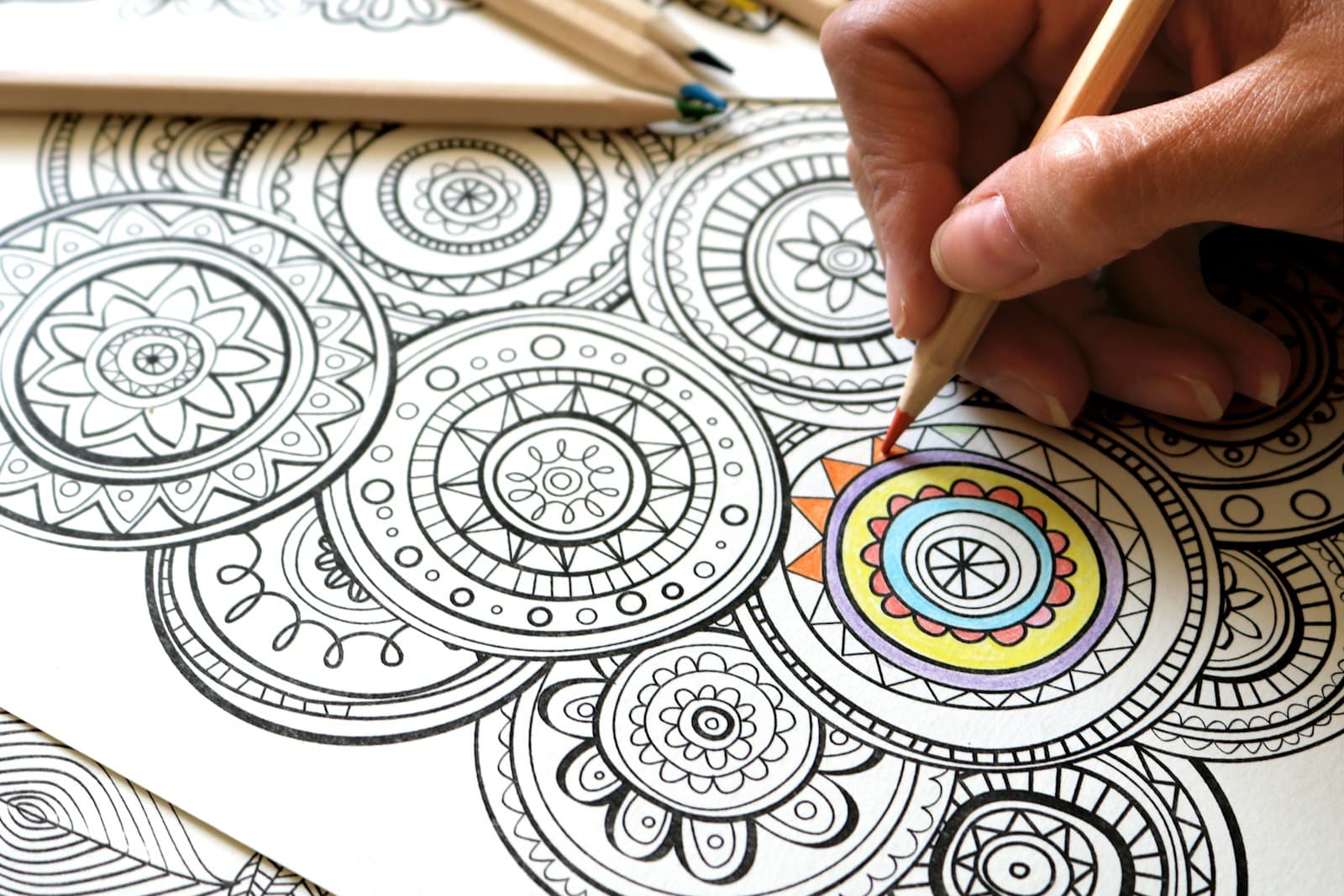
Try mindful coloring
Pick up some pencils and a coloring page and let the repetitive strokes quiet your mind.
- Time:
- 30 min
- Cost:
- low
- Difficulty:
- easy
- Where:
- Indoors
- Best:
- Solo
When you try mindful coloring it occupies your hands and just enough of your mind to interrupt rumination, without demanding the creative decisions that make drawing stressful for people who think they cannot draw. The lines are already there. All that remains is color choice and the repetitive motion of filling in.
Why try mindful coloring is worth an hour
Repetitive structured activity with a low failure rate is unusually good at settling attention. There is no wrong answer, no blank page and no skill threshold, which removes the self-evaluation that interferes elsewhere. Working slowly on a small area rather than racing to complete the page is what keeps it a practice rather than a task to finish.
How to try mindful coloring step by step
- 1
Choose a design with fine detail
Mandalas and patterns work better than pictures. Detail slows you down, which is the point.
- 2
Pick a limited palette first
Five or six colors. Choosing from forty pencils each time reintroduces decision-making you came here to avoid.
- 3
Work on one small section
Rather than the whole page. Finishing is not the goal and treating it as one changes the activity.
- 4
Notice the physical sensation
Pencil on paper, the sound, the pressure. This is what makes it mindful rather than merely occupying.
- 5
Set a timer and stop when it ends
Mid-section is fine. Stopping deliberately keeps it a practice rather than a task to complete.
Tips to get more out of it
- Pencils give more control than felt tips and let you build color gradually, which suits the slow pace.
- Repeating a color across the page creates coherence without requiring any design decisions.
- If you find yourself rushing to finish, that is worth noticing. Slow it down rather than pushing through.
Ways to mix it up
If printed books do not appeal, drawing your own repeating pattern and filling it in is the same activity with an extra stage. If you want more structure still, zentangle-style pattern drawing follows explicit rules and occupies the mind similarly.
Try mindful coloring: frequently asked questions
Does coloring actually reduce anxiety?
Many people find structured repetitive activity settling, and coloring has the advantage of no skill threshold and no wrong answers.
What kind of design works best?
Detailed patterns and mandalas rather than pictures. Fine detail slows you down, which is what makes it work.
Do I need to finish the page?
No, and treating it as something to complete changes the activity. Set a timer and stop wherever you are.
Related activities
Creative
Do some finger painting
Finger painting for adults can be a simple way to explore colour and marks without a brush.
Creative
Start a doodle-a-day challenge
Commit to one small doodle a day and watch your sketchbook—and confidence—fill up.
Creative
Try your hand at watercolor painting
Experiment with watercolour washes, blending, and layering to create soft, flowing artwork with this forgiving medium.