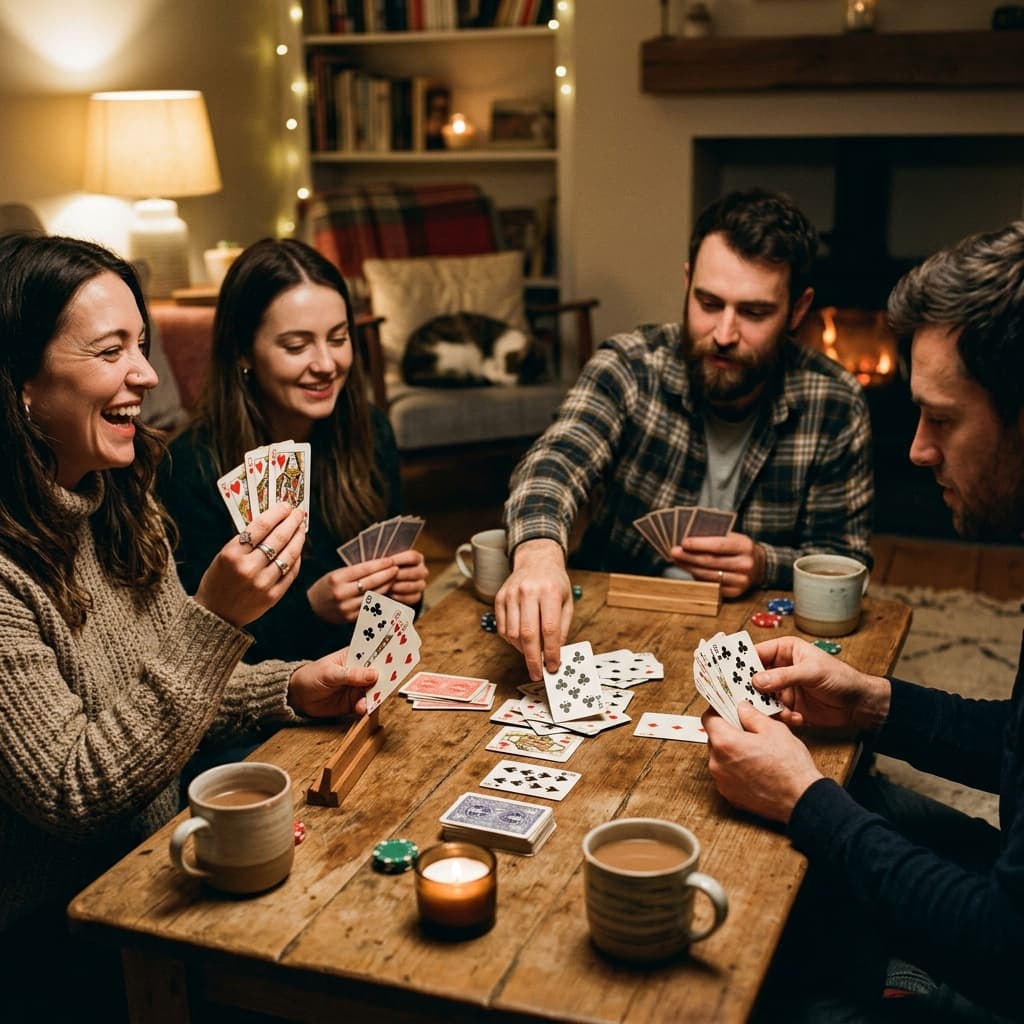
Learn a new card game
Pick up a game like Cribbage, Euchre, or Rummy—card games are portable, social, and endlessly replayable.
- Time:
- 45 min
- Cost:
- low
- Difficulty:
- easy
- Where:
- Indoors
- Best:
- With others
A standard deck supports hundreds of games and most households play two. To learn a new card game takes about twenty minutes, and the fastest route is to grasp the objective before any of the detailed rules, because every specific rule makes sense only in terms of what you are trying to achieve.
Why learn a new card game is worth an hour
Card games cluster into a few families: trick-taking, shedding, matching, accumulating. Recognizing which family a new game belongs to means you already understand most of its structure, and only the particular scoring and exceptions remain. Playing the first hand with everyone's cards face up removes the guesswork entirely and shortens the learning by half.
How to learn a new card game step by step
- 1
Learn the objective before the rules
How do you win? Every individual rule only makes sense once you know what it is in service of.
- 2
Identify the family it belongs to
Trick-taking, shedding, matching, accumulating. Knowing the family gives you most of the structure immediately.
- 3
Play one hand with cards face up
Everyone's hand visible, discussing the choices. It halves the learning time and nobody minds losing.
- 4
Write the scoring down
Scoring is where disputes and confusion arise. A visible reference stops the game stalling.
- 5
Play three hands before judging
The first is rules, the second is mechanics, the third is where the actual game becomes visible.
Tips to get more out of it
- Two-player games are a specific category. Many classics need three or more to work at all.
- Video explanations beat written rules for most games. Watching one hand played is worth pages of text.
- Regional variations are everywhere. Agree which version you are playing before you start rather than mid-hand.
Ways to mix it up
If you are usually two people, learn a dedicated two-player game rather than adapting a larger one, since adaptations are consistently worse. If you want something quick, shedding games take minutes to learn and suit mixed ages far better than trick-taking games do.
Learn a new card game: frequently asked questions
What card games work with only two players?
Games designed for two, rather than adaptations of larger ones. Cribbage, gin rummy and piquet are all built for a pair.
How do I learn a card game quickly?
Learn the objective first, then play one hand with all cards face up. Open practice halves the learning time.
Why do people play the same game differently?
Regional and family variations are extremely common. Agree which version you are using before the first hand.
Related activities
Games
Learn a new solitaire variation
Go beyond Klondike — learn Spider, FreeCell, or Pyramid and you'll never be bored with a deck of cards.
Games
Try a new board game
Explore modern board games beyond Monopoly—strategic, cooperative, or party games that offer fresh challenges every time.
Social
Organize a game night with friends
Gather your crew for board games, card games, or trivia—an easy, low-cost way to have a great time together.